Interpreter vs Translator: What's the Difference; How to Choose?
Understand the differences between interpreters and translators. Get guidance on how to choose the right professional career for you

If you love languages and are interested in exploring cultural differences, then becoming an interpreter or translator will make a good choice. Both professions involve facilitating communication across different languages, yet they require distinct skills and serve different purposes. Knowing the differences between these roles can help you choose the one that best matches your interests and abilities.
In this article, we describe the roles of interpreters and translators, the necessary qualifications and differences, which will help you decide on a career path.
What is an Interpreter?
Interpreters act as a link between two people who use different language, and they translate both spoken or sign language in an interpreting setting. Interpreters work in various settings, such as conferences, courtrooms, hospitals, and business meetings. Their primary role is to ensure that conversations flow naturally, bridging language barriers to promote understanding.
A good interpreter must be able to listen and speak well since he or she has to translate messages within a short span of time and without distorting the meaning. They often specialize in a particular field, such as legal, medical, or technical interpretation, to ensure they understand the context and terminology used in conversations.
What is a Translator?
A translator converts written text from one language to another while maintaining the original meaning, tone, and context. Translators work with documents, websites, books, manuals, and more. Unlike interpreters, they have the advantage of time, allowing them to research terminology and refine their translations for accuracy and readability.
Strong reading and writing skills are essential for translators, as they must preserve the style and cultural nuances of the source text. As with interpreters, they might further categorize themselves by the type of translation they work on, legal, technical or literary so that the product complies with industry standards
Interpreter vs. translator
Although interpreters and translators share a common goal of facilitating communication across languages, their roles differ significantly:
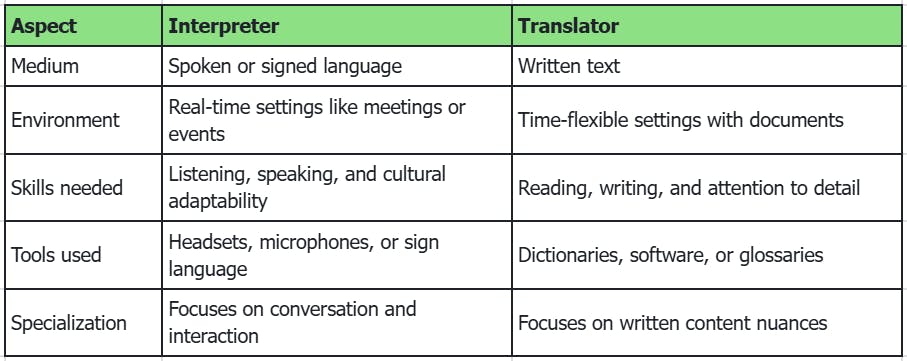
How to Choose Between Being an Interpreter or Translator
Based on skills, preferences and personality, you has to determine whether to be an interpreter or a translator. Interpreters generally work under high, real-time interaction and thus the job is suitable for people who embrace pressure and are good communicators. These people can easily communicate in public and have good decision-making skills and flexible personality.
In contrast, the translators are most proficient in reading and writing skills. They do not like group work and usually like to have time to work on their projects and make corrections. Translation might be the better choice if you are fine with details and you like to investigate written words.
To decide, consider testing your strengths in both areas. For instance, you could offer your services as an interpreter or attempt to translate some papers to determine what suits you or not.
Emerging Trends in Interpretation and Translation
The interpretation and translation fields are evolving rapidly, thanks to advancements in technology and globalization. Here are some emerging trends shaping these professions:
- AI and Machine Translation
Tools like AI-powered translation software are becoming more sophisticated, assisting translators with basic tasks and enabling faster workflows. However, the human touch is still required in order to convey the cultural meanings and the emotional sentiment of the utterance. - Remote Interpretation
Remote interpreting has been on demand due to virtual meetings and events that have become common due to the Covid-19 pandemic. Today, platforms are built with the live interpretation option that enables interpreters to hold the position remotely. - Specialization in Niche Fields
Some industries such as healthcare, legal services, and entertainment need interpreters and translators with specialized knowledge of certain terms. This means that there is a very big advantage of specializing in a given area of practice. - Cultural Consulting
Apart from language, business people may need advice on matters of culture. Interpreters and translators are expanding their roles to act as cultural consultants, ensuring effective communication across different contexts. - Sustainability in Localization
The global companies are going for sustainable localization processes in order to ensure the business messages are appropriate in different culture.
Conclusion
Interpreters and translators are essential in ensuring that language barriers are bridged and that cultural differences are well understood. Though both jobs involve working with languages and excellent communication skills the two jobs entail varied tasks, working environments, and abilities.
Which of these paths to follow is really a matter of one’s abilities, passions, and the way one wants to work. Interpreters have fun when doing their job because the job involves rapid interaction while translators also find their job fulfilling because it involves details.
As the world becomes increasingly interconnected, the demand for skilled interpreters and translators continues to grow. By staying informed about industry trends and honing your expertise, you can build a rewarding career that bridges gaps between people, cultures, and languages.
Check Out More Jobs in Singapore Now
Latest Job Vacancies in Singapore are available and always updated. Start Your Career Path with Ricebowl Today! Full-time, part-time, internship.
Tired of Applying for Jobs One by One?

At Ricebowl, we understand that finding the right job can be a challenging and time-consuming task. Don't miss this opportunity to simplify your job search and let employers discover you! Drop Your Resume at Ricebowl and Start Landing your Dream Job Today!