Know Your Rights As An Employee for Public Holidays Malaysia
by AJobThing Team
Dec 27, 2024
at 12:15 PM
How many Public Holidays in Malaysia?
Malaysia has 15 federal public holidays. However, when you include both federal and state holidays, the average number of public holidays in Malaysia is around 19 days.
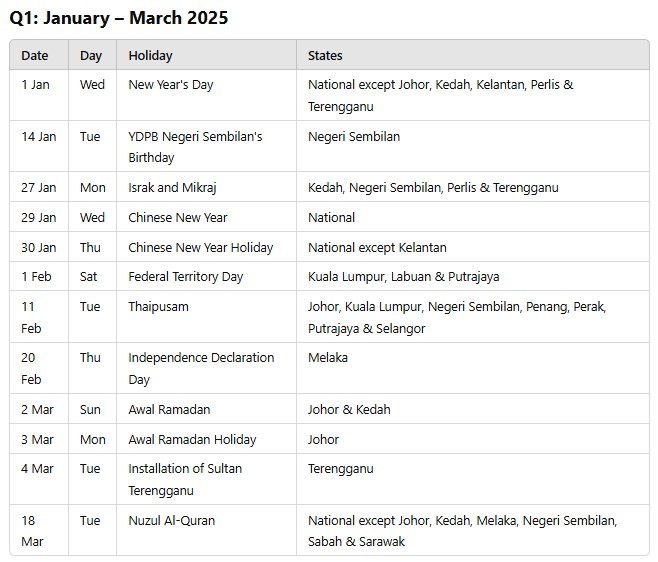
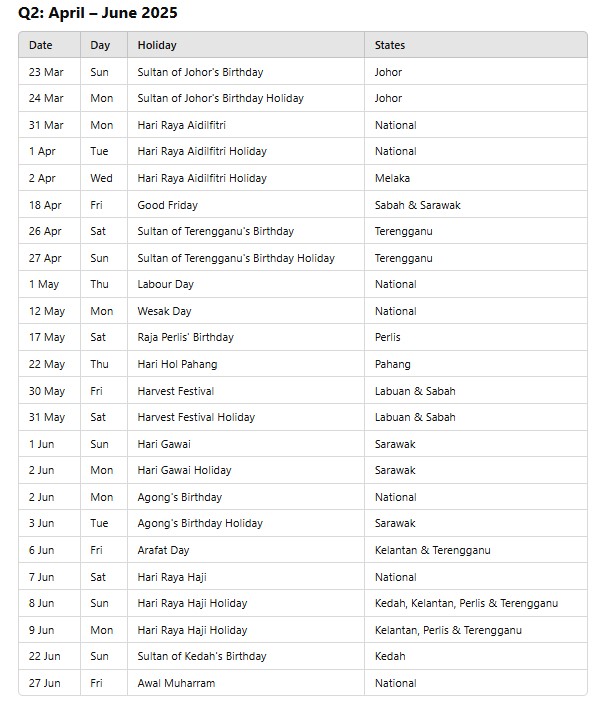
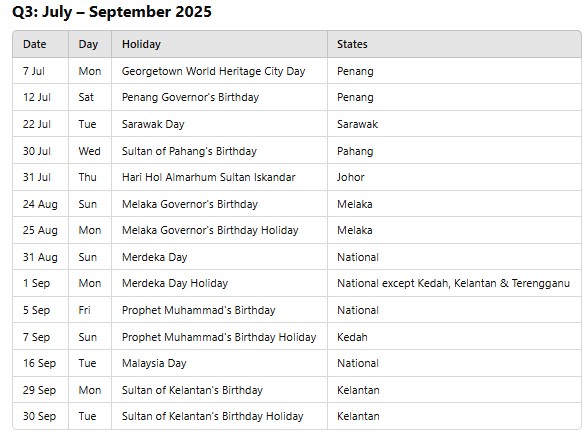
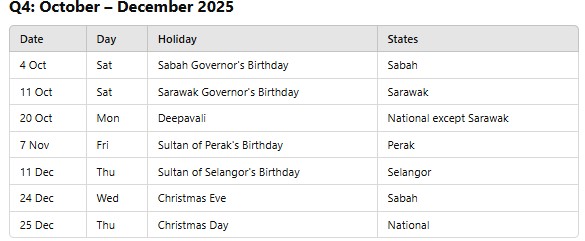
The Calendar for Public Holidays in Malaysia 2025
Public Holiday Malaysia January, Febraury, March 2025
Public Holiday Malaysia April, May, June 2025
Public Holiday Malaysia July, August, September 2025
Public Holiday Malaysia October, November, December 2025
The List of Public Holidays in Malaysia
The First Schedule of the Holidays Act provides a list of all the recognized public holidays.
Know Your Rights as an Employee for Public Holidays
Every employee in Malaysia is entitled to the 11 gazetted public holidays in Malaysia and any day specified as a public holiday under Section 8 of the Holidays Act under Section 60D of the Employment Act.
State level holidays is not mandatory for employers to acknowledge these holidays. If businesses choose not to declare certain state level holidays as paid holidays, employees must continue working as usual.
There are some exceptions to this rule. For instance, Federal Territory Day must be observed in the federal territories (Kuala Lumpur, Putrajaya, and Labuan). Similarly, the Ruler's Birthday or the Yang di-Pertua Negeri's Birthday must be observed in other states.
5 Compulsory Public Holidays in Malaysia
Under Section 60D, employers are mandated to provide a list of 11 gazetted public holidays to employees before the start of each calendar year.
Among these 11 holidays, there are 5 Compulsory Public Holidays in Malaysia:
National Day: Celebrated on August 31st each year, this day marks Malaysia's independence from British colonial rule in 1957.
Malaysia Day: Observed on September 16th annually, this day commemorates the formation of Malaysia in 1963.
The Birthday of the Yang di-Pertuan Agong (King's Birthday): This holiday is celebrated on the first Saturday of June each year.
Labour Day: Celebrated on May 1st every year, this day honors all workers and employees across the country.
Birthday of the ruler or governor of the state (e.g., Federal Territory Day in the federal territories): This holiday varies depending on the specific state and its ruler or governor.
The list above shows the 5 compulsory public holidays in Malaysia. Employers can choose the remaining 6 holidays to make up the 11 holidays. This means employers can ask employees to work on days like Chinese New Year, Hari Raya Aidilfitri, or Deepavali.
As mentioned earlier, employers are required to provide a list of 11 gazetted public holidays at the start of each calendar year.
What happen if a public holiday in Malaysia falls on a rest or non-working day?
Public Holiday Falling on a Rest Day (Saturday or Sunday)
In Malaysia, if a public holiday falls on a rest day or a non-working day, such as a Saturday or Sunday, employees are entitled to a paid holiday on the following working day (usually Monday). This additional day off is known as a replacement public holiday or a substitute holiday. This rule is outlined in the Malaysian Employment Act of 1955.
Public Holiday Falling on a Non-Working Day (usually Monday)
If a public holiday falls on a non-working day (usually Monday), employees usually don't get an extra day off or a replacement holiday. They should carry on with their normal work schedule.
Rate of Pay on Public Holidays
Rate of Pay on Public Holidays = Ordinary Hourly Rate of Pay x 2
Overtime Rate of Pay Per Hour on Public Holidays = Ordinary Hourly Rate of Pay x 3
The minimum hourly pay rate for work performed on public holidays is higher than usual. On public holidays, the regular pay rate must be at least double (2 times) the regular pay rate on normal working days.
For overtime work on public holidays, the pay rate should not be less than triple (3 times) the regular pay rate on normal working days.
This is governed by Section 60D(3aa) and (3aaa), which mandates that the pay rate for work done on public holidays should be no less than three times (3 times) the hourly rate of pay during regular working hours.
Additional public holidays (Additional holidays announced by the Minister)
An additional holiday is a special day that's not officially listed as a public holiday but is announced by the Government. This is done under Section 60D(1)(b) of Act 265 and Section 8 of the Holidays Act 1951 (Act 369).
Section 8 of the Holidays Act lets the Minister decide when to make a day a public holiday. This means the Minister in Charge can declare any day as a public holiday in the Peninsular, Federal Territories, or certain States (after talking to the States).
When there's an additional holiday, employers must either give employees the day off on the announced date or offer another day as a paid public holiday instead.
Generally, Act 265 sets the minimum rules, and employers can choose to provide leave for public holidays beyond the required 11 days per year. It's a good practice for employers to grant leave on all public holidays declared by the Government.
In conclusion, employees in Malaysia are typically entitled to 11 paid public holidays each year. On these days, employees have the right to take a break and receive holiday pay, which is higher than their regular pay to acknowledge their hard work during these special times. Out of these 11, employers can select 6 as official paid holidays. However, it's important to note that the Minister has the authority to declare special holidays on occasion.
During these public holidays, employees have the right to a day off with holiday pay. Usually, the pay rate for working on these days is at least double the regular hourly rate. And if they work extra hours, like overtime, on these days, they should get at least triple the regular pay. This ensures that employees are compensated fairly for their time and dedication on public holidays.
Ready to take the next step? Submit your resume at Ricebowl today and let us help you stand out to recruiters. Your dream career is just a click away!